Home · The Instructor
A teacher measured by his students.
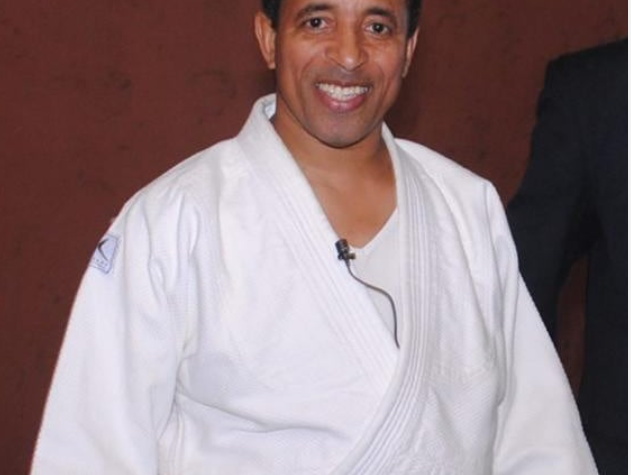
Aziz Meknassi
For Aziz Meknassi, Aikido has never been simply something practised for a few hours each week. It has followed him from childhood in Casablanca to family life in Coventry, through different teachers, different martial arts and more than four decades of training.
And it began when he was twelve.
A lifetime of Aikido
I began studying Aikido in Casablanca, Morocco, in 1983, at the age of 12, under Bahadou Abderrahman Sensei, 6th Dan of the Moroccan Aikido Federation.
I served as his uke and assistant for many years, and in 1989, when I turned 18, I obtained my black belt. I then began teaching Aikido to adults at Budokan du Maroc, as well as teaching children at various public and private clubs throughout Casablanca.
Aikido became very much a part of my family life too. There was a time when almost my entire family practised at Budokan du Maroc — from my father all the way down to the youngest cousin.
Looking back, perhaps it was inevitable that many years later I would want to pass the same experience on to my own children.
More than Aikido
Bahadou Sensei's teaching exposed me to much more than one martial art.
Under his guidance I also practised Việt Võ Đạo, a Vietnamese martial art, as well as Tai-Jutsu, Kung Fu, Aikibudo and other disciplines.
Through those years I had the opportunity to meet and train with many experts from different martial arts.
That broader martial arts experience became an important part of the way I understood Aikido.
Two sides of Aikido
The Aikido we practised in Casablanca had two sides.
Traditional Aikido
Practitioners were expected to know the Aikikai syllabus for their national grading, chaired by M'barek Alaoui Sensei, the first 8th Dan in Africa.
Those who could afford the Aikikai fees could instead take their international Aikikai grading, chaired by Nobuyoshi Tamura Shihan.
The examinations themselves were the same. The Aikikai fees were the only difference.
This meant that the traditional syllabus and technical standards were an important foundation of our training.
Modern Aikido
Alongside this, we practised a more modern Aikido that had evolved with time and was also taught as a practical self-defence tool.
So from quite early in my training I experienced Aikido both as a traditional Japanese martial art, with a recognised syllabus and grading structure, and as something that could continue to evolve and be applied practically.
Both have remained important to the way I approach Aikido today.
When I moved to Coventry, I met a great gentleman called Tom Moss Sensei, head of Phoenix Aikido Club.
Admittedly, I did not train with him for very long, but whenever I did, I enjoyed his classes immensely.
Tom Sensei could make anyone love Aikido.
His own Aikido was beautiful, and although our time together was relatively short, he left a lasting impression on me.
Sadly, Tom Sensei has since passed away.
I remain grateful that I had the opportunity to know and train with him and i am still in touch with some of his students and occasionally train with Ric Costigan at Stratford Phoenix Aikido
Continuing the journey
In 2001, I was graded 4th Dan under Patricia Guerri Sensei, 7th Dan, who had been a direct disciple of Morihiro Saito Sensei for 12 years.
Later, in 2009, I began training and teaching at Chishin Dojo, where I met John Burn Sensei, and remained there until 2012.
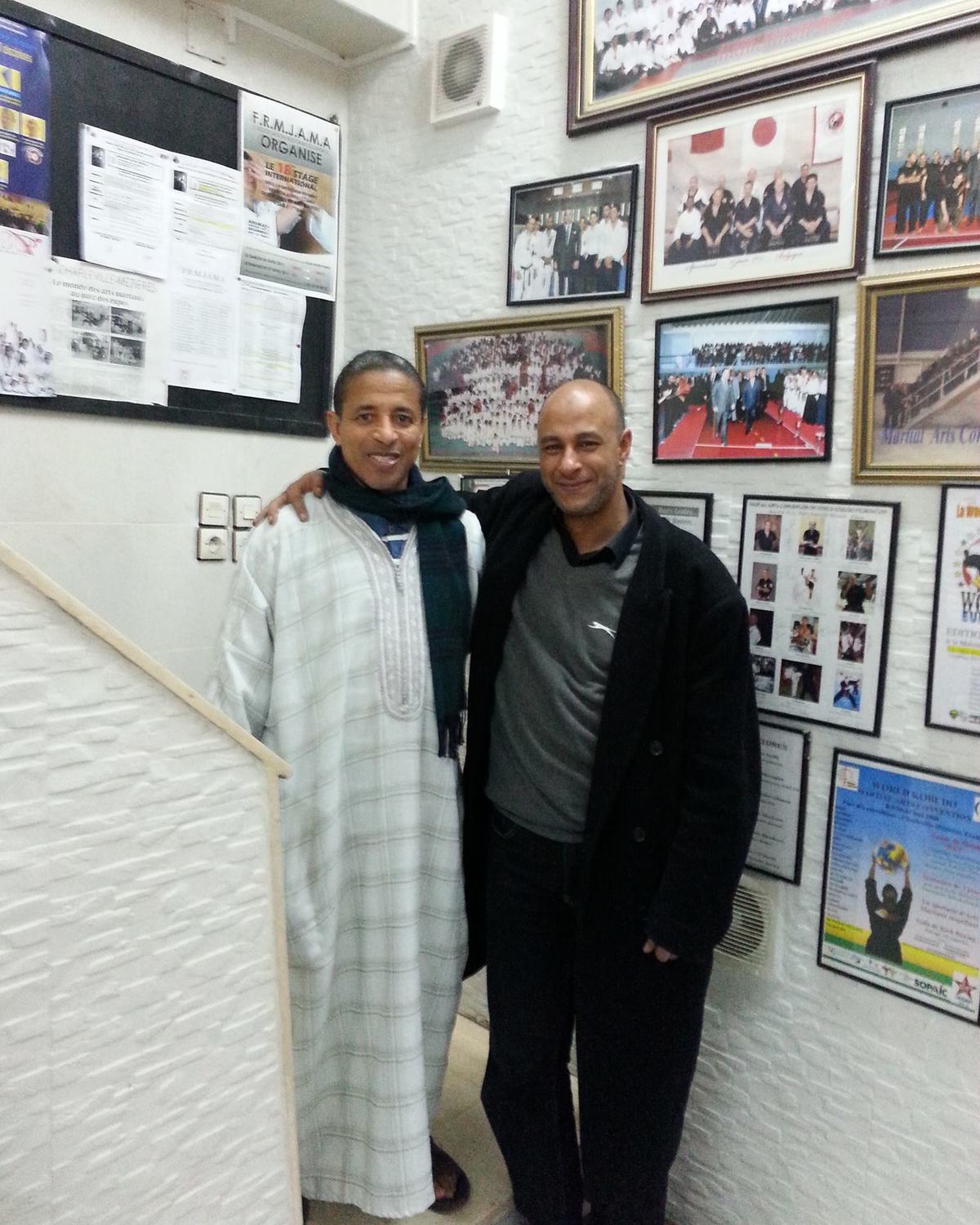
Throughout all these years, however, I have remained in touch with Bahadou Sensei.
Whenever the opportunity allows, we still meet — and I continue to receive his teaching and wisdom.
More than four decades after I first stepped onto the mat in Casablanca, I still regard the relationship with my first teacher as an important part of my Aikido.
The beginning of Hizashikan
Eventually, I decided to establish my own dojo.
There were several reasons.
One was very personal: I wanted to pass on what I had learned to my children and my family.
I also wanted somewhere where I could continue to train, learn and develop my own Aikido.
Friends soon heard about what we were doing and decided that they wanted to join us.
There was another principle that mattered to me too.
I wanted a dojo that could concentrate on Aikido rather than organisational politics.
The training came first.
The students came first.
At that point, however, the dojo still didn't have a name.
陽射し館 — The name Hizashikan
The place of sunlight.
> He that has the spirit of the sun within him can achieve anything.
That changed in 2011, when I met and trained under Terry Ezra Shihan.
It was Terry Ezra Shihan who gave us the name:
Hizashikan Dojo
And the dojo finally had an identity of its own.
What had begun as somewhere for me to continue training and pass Aikido on to my children and family had gradually become a community of students in Coventry.
Today, Hizashikan continues in that same spirit.
Aikido beyond the mat
For me, Aikido isn't something that exists only for a training session or two each week.
Over the years, it has become a way of life.
I try to apply its philosophy in my daily life, and throughout my non-martial arts careers I have repeatedly found situations where the principles of Aikido apply.
The dojo is where we practise them.
Life is where we discover whether we have understood them.
And after all these years, I still consider myself a student.
My teaching style is unhurried and personal. Beginners are partnered carefully. Children are given the same seriousness as adults, and adults the same encouragement as children. The quietest student in the room gets the most attention — because that is how I was taught.
**Aziz Meknassi**
Chief Instructor, Hizashikan Aikido
Hizashikan Aikido is a proud member of the BMABA Association.
Training journey
1983 — Casablanca
Began studying Aikido aged 12 under Bahadou Abderrahman Sensei at Budokan du Maroc.
1989
Obtained black belt aged 18 and began teaching adults at Budokan du Maroc and children at public and private clubs in Casablanca.
2001
Graded 4th Dan under Patricia Guerri Sensei, 7th Dan and direct student of Morihiro Saito Sensei.
Coventry
Trained with Tom Moss Sensei of Phoenix Aikido Club.
2009–2012
Trained and taught at Chishin Dojo after meeting John Burn Sensei.
2011
Met and trained under Terry Ezra Shihan, who gave the dojo the name Hizashikan.
Today
Teaching Aikido to children and adults in Coventry while continuing to train, learn and maintain the connection with Bahadou Sensei that began in Casablanca in 1983.
The dojo today
Hizashikan is a not-for-profit Aikido dojo in Coventry and a member of BMABA.
Children and adults train together within the same tradition Aziz inherited from his own teachers: serious about the art, patient with the student and always open to learning.
You do not need martial arts experience to begin.
Every one of us started where you are now.
“My job is not to make Aikido look impressive. It is to make you believe you can do it — because you can.”
The teacher behind the teacher
In Aikido, lineage matters — not as a boast, but as a promise. What is taught at Hizashikan was learned, hand to hand, from Shihan Abderrahman Bahaddou, and through him from the generations before. When you train here, you join that line.